Fear of memory loss and cognitive decline
The Thursday Murder ClubFear of memory loss and cognitive decline runs through life at Coopers Chase as more than worry about misplaced names or forgotten errands: it is fear that the self may become inaccessible before the body fails. The residents’ daily routines offer ways to test and preserve mental ability, but Stephen’s deterioration shows how care, uncertainty, and the wish to postpone loss can become difficult to separate.
A fear shared at Coopers Chase
Coopers Chase is a retirement community established on land sold by the Catholic Church. Its residents, who must be over sixty-five, live around the former convent, whose long history and surroundings make the past unusually present. The convent once housed the Sisters of the Holy Church; nearby, the Garden of Eternal Rest holds generations of their dead. The setting places later life among both the accumulated traces of other lives and the prospect of one’s own ending.
Against that backdrop, forgetfulness is described as a bogeyman stalking the community. A missed name or an absent-minded moment may have an ordinary explanation: someone may confuse a daughter’s name with a granddaughter’s while thinking about something else. Yet the uncertainty itself is troubling. Residents can joke about lapses, and family members may keep a watchful eye, while the person experiencing them privately fears a more serious change. The imagined loss is not simply of information but of the journeys, games, social ties, and recognizable identity that make up a life.
Elizabeth’s early-warning system
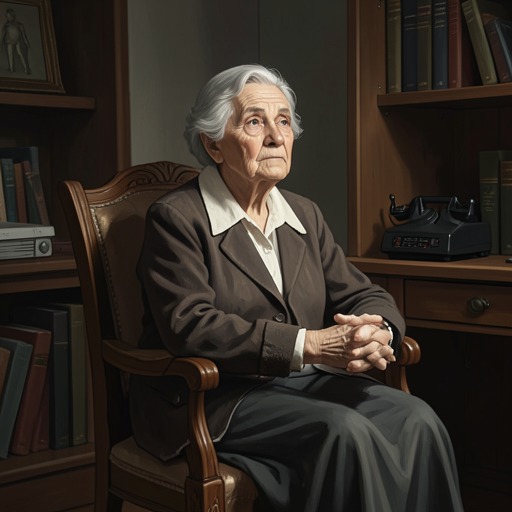
Elizabeth responds to that uncertainty with a deliberate routine. Each day, she opens her diary to a date two weeks in the future and writes herself a question. She then answers a question she set two weeks earlier, turning recollection into a repeated, personally designed check. The interval gives the test a practical edge: the answer depends on what she can still retrieve after time has passed, rather than what she has just been told.
One test concerns a car’s number plate from a fortnight earlier, which Elizabeth remembers correctly and takes as reassurance. Another small uncertainty has already prompted her to examine what a lapse might mean: she has failed to catch the name of Gwen Talbot’s daughter-in-law, whom she met only once. Elizabeth attributes the omission to hearing rather than memory. The distinction matters because the same blank can be interpreted either as an ordinary failure of attention or as evidence of a frightening change.
The diary therefore offers more than a record. It gives Elizabeth a way to observe herself over time and to make an uncertain process feel measurable. Its questions are a private form of surveillance, but also a means of retaining agency: rather than waiting for others to notice a decline, she creates her own test and decides how to read the result. The routine cannot guarantee what the future will bring; its value lies in making a feared change something she believes she might detect early.
Stephen and the limits of private care
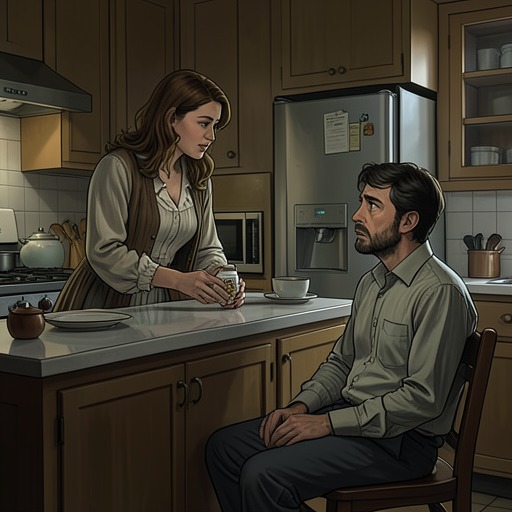
Elizabeth’s concern becomes more immediate in her life with Stephen. When she returns home, he is absorbed in concentration, but their morning conversation has revealed a serious confusion: Stephen speaks of Emily as his daughter and hopes she will visit more often. Emily was his first wife, who died nearly twenty-five years earlier; Stephen has no children. The mistaken relationship makes the past feel not merely remembered imperfectly but rearranged in the present.
Stephen’s writing carries another sign of change. He continues to write every day, sometimes for hours, and keeps his work locked away, though Elizabeth reads it. Some pages repeat material copied from a newspaper; others tell stories about Emily or are written for her, in beautiful handwriting. Writing remains an activity he can sustain, yet its repetition and its return to Emily sit alongside the evidence of confusion. The same practice can preserve his connection to a life he remembers and disclose how much that past occupies him.
Elizabeth recognizes that Stephen is near, or already beyond, the point at which he can continue his former life. Trips to London, exhibitions, and visits to the British Library are no longer part of his future as she understands it. She is choosing to manage his condition herself, including by giving him medication that sedates him so he will not wake during the night. She expects that a fall or illness could bring him before a doctor who would recognize the situation, ending her ability to keep it private. Her care is thus bound up with concealment and with an effort to delay a separation she knows may be approaching.
Memory, community, and the past
At Coopers Chase, mental ability is also part of social life. The Cryptic Crossword Club’s weekly challenge turns solving into a visible measure of skill: Irene Dougherty has won Colin Clemence’s challenge for three weeks running when Frank Carpenter accuses her of impropriety. After a profane clue is left on Colin’s door, the club is postponed to let tempers cool. The episode concerns a dispute, not proof of anyone’s cognitive decline, but it shows how closely mental performance can be observed and judged in a community where games and clubs matter.
The past is not held only in individual recollection. When residents examine old albums for photographs from a Christmas gathering at the convent, the group studies six black-and-white pictures and returns to one group image, looking again until they agree on what it shows. The photographs provide evidence that a person’s unaided memory cannot supply by itself. In a story where names and identities may become uncertain, shared attention to records and one another’s recollections offers a counterweight to private doubt.
The fear of decline consequently has two scales. For the community, it shadows ordinary conversation and threatens the activities through which residents remain part of one another’s lives. For Elizabeth, it becomes a daily test and a decision about how long Stephen can be protected from outside scrutiny. The diary can register an answer, and a photograph can prompt recognition, but neither can promise that memory will remain intact. Their importance lies instead in the acts of attention they make possible: checking, remembering together, and continuing to care when certainty is no longer available.